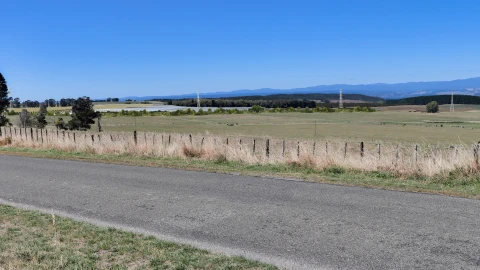
The solar farm would be built on an existing dairy farm on Karangahape Road, a no-exit rural road off State Highway 32 on the western side of Lake Taupō. A new transmission line would run for approximately 9.7 kilometres from the solar farm to a grid connection point west of State Highway 32, where the project would connect to the Bunnythorpe–Whakamaru 220kV lines.
Western Bays Solar Farm
We’re proposing to build a large-scale solar and battery development on the western side of Lake Taupō that could generate enough clean, renewable electricity to power around 113,000 average homes.
The project is a proposed 420-megawatt solar farm with a battery energy storage system. It would generate around 870GWh of renewable electricity each year—about 2% of New Zealand’s current electricity generation—and help meet growing demand as homes, transport and industry move to electricity.
The above image is a visual simulation of what the solar farm would look like 5 years following construction.
Project details
Generation capacity: up to 420MW
Expected annual generation: around 870GWh
Equivalent household supply: around 113,000 average homes
Solar farm area: approximately 620 hectares together with a transmission line, substation, Grid Injection Point and ancillary buildings and infrastructure
Battery storage: 250MW, with up to eight hours of storage
Transmission connection: approximately 9.7km 220kV transmission line, supported by towers up to 60 metres high
Construction period: approximately five years
Expected operating life: at least 35 years
The development would include solar photovoltaic panels, inverters, battery storage and power-conversion units, underground electrical cabling, an on-site substation, operational buildings, access and security infrastructure. Sheep grazing is intended to continue beneath the panels, helping retain productive agricultural use of the land.
Obtaining resource consent
The project has been accepted for referral into the Fast-track Approvals process and we expect to lodge a substantive application in early 2027. You can view the fast-track referral application documents we submitted below. The substantive application will include significantly more detail on the consent design and effects assessments.
Read the referral application documents on the Fast-track website: Western Bays Solar Farm
In preparing the application, we have engaged a team of technical experts to assess the project’s potential economic benefits and environmental effects, including landscape and visual, noise, ecological and archaeological effects.
We have also engaged with a range of stakeholders to better understand local views on the potential impacts and benefits of the project. This has included mana whenua, landowners, neighbours, councils and the Department of Conservation.
What happens next?
Once we lodge the substantive fast-track application, it will be considered by an expert panel. Expert panels are independent decision-making bodies set up for each fast-track project.
The panel may invite comments and organise other information or activities required to support their decision, possibly including a hearing.
The panel will then issue its decision. If the application is approved, the panel will specify the consent conditions the project must meet.
This process is set out in more detail here: https://www.fasttrack.govt.nz/process/process-overview
If approved, a detailed design process for the project will be carried out, along with the development of a business case that will be taken to the Meridian Board for a final decision.
Our project team will continue to engage with mana whenua and the local community throughout the process.
If the Western Bays project goes ahead, construction could begin in late 2028.
Economic and energy benefits
Local and regional businesses would benefit through local spend and employment during construction, including civil, mechanical and electrical contracting, fencing, planting, freight, logistics, accommodation, hospitality, transport and traffic management roles. The completed project would also generate permanent employment.
By adding significant renewable electricity generation and storage in the North Island, the project would help strengthen electricity supply, support the integration of renewable energy and reduce pressure during peak demand and dry years.
Assessment of potential effects
We have undertaken technical investigations to assess potential effects on landscape and visual amenity, glint and glare, ecology, long-tailed bats, noise, transport, flooding, drainage, earthworks, groundwater, contaminated land, cultural values and archaeology.
The assessments show that all adverse effects of the project can be appropriately managed through design, mitigation measures and consent conditions. Landscape and visual effects would be most noticeable near the site and along Karangahape Road, reducing with distance and boundary planting. The solar panels are not visible from Lake Taupō.
There are no confirmed archaeological sites recorded within the project footprint. The site has an existing wetland that will be retained.
Construction effects such as noise, traffic, dust, vibration and sediment control would be managed through management plans approved by the Regional or District Councils. Some local road improvements are potentially required. Stormwater, groundwater and earthworks would be managed through appropriate controls, consents and remediation.
Proposed construction approach
Construction is expected to take approximately five years. The current approach is to build the northern half of the solar farm first, together with the substation, transmission line and grid connection, followed by the southern half and removal of temporary construction facilities.
Power Up community fund
Meridian’s community fund Power Up supports local projects in the areas near our generation assets. It’s one way we can recognise the importance of local communities to our hydro and wind operations.

Tackling Zero
Tackling Zero is Meridian’s quarterly newsletter for people whose roles or studies are focused on sustainability, or for whom this is an area of interest. Each issue will offer Meridian’s insights into a topical sustainability issue, as well as stories on how we, our customers and supply chain partners are tackling sustainability. It also includes links to recent Meridian disclosures such as new policies and reports.