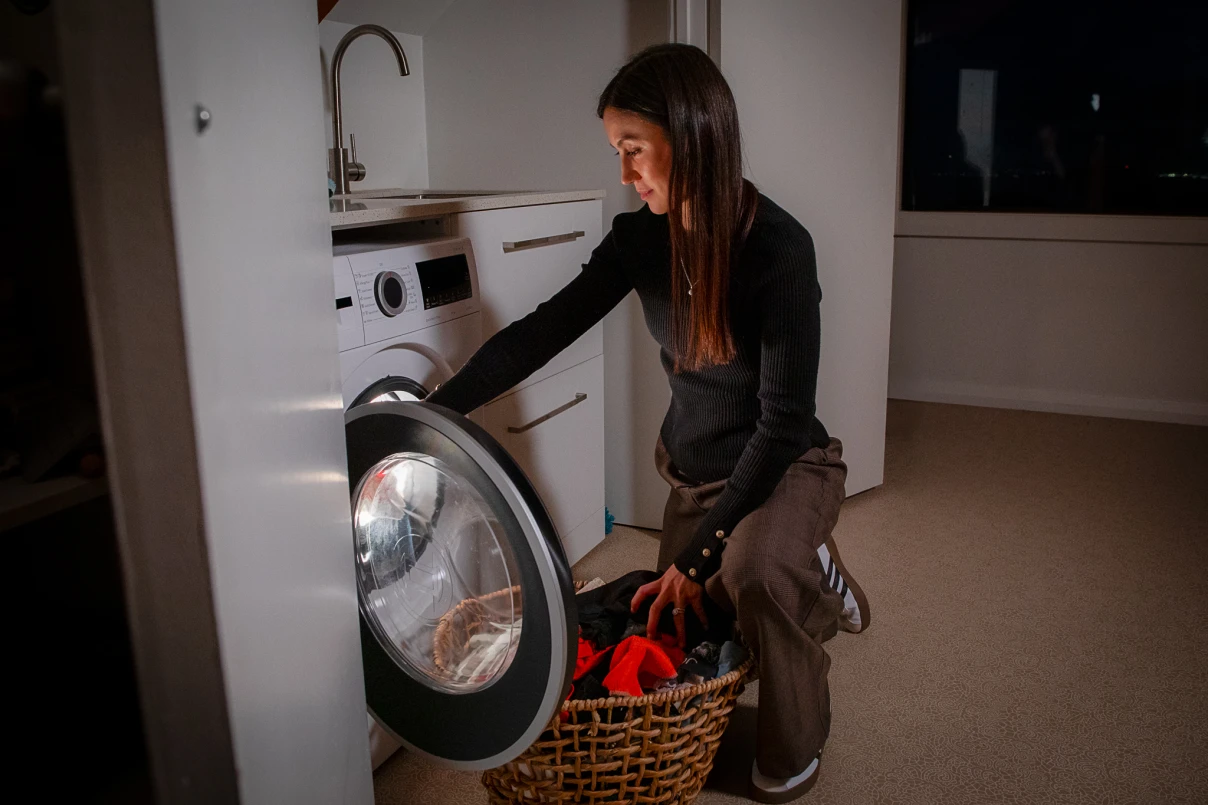
Because rates differ between plans and regions, the most useful number is the gap between your day rate and your night rate. Your bill or plan details will show both. The table below shows what every 10c per kWh of difference is worth over a year. If your gap is 15c, multiply by one and a half. If it's 20c, double it.
|
What you move to off-peak
|
Energy moved per year
|
Worth for every 10c/kWh gap
|
|
3 warm washes a week
|
187 kWh
|
About $19
|
|
3 vented dryer loads a week
|
468 kWh
|
About $47
|
|
5 warm washes and 5 vented dryer loads a week
|
1,092 kWh
|
About $109
|
|
Dehumidifier, 4 hours a night, every night
|
730 kWh
|
About $73
|
These are straight calculations rather than a promise of savings. What you'll see depends on your rates and how consistently the loads move.
Finding a routine that fits
There's no single right way to do this. Here's how off-peak laundry can look for a few different households.
If you work standard hours
-
Load the washing machine before bed and use delayed start so it finishes around the time you get up.
-
Hang it out before you leave, or pop it on an airer.
-
Save the dryer for wet weeks, and run it after 9pm while you're still up.
If you're a night owl
You're already awake in the lower-rate window. After 9pm is a natural time to run a load, move it to the dryer or airer, and still be up when it finishes.
If you're an early riser
A load started at 5am is usually done well before 7am. Many machines have an end-time setting, so you can load it the night before and have it finish as you're making the first coffee.
If you work shifts
Your routine may already line up with the lower-rate hours. A wash started while you get ready for a late shift, or when you get home in the early hours, can land in the window without any extra planning.
If you have a busy family home
With young kids, the washing sometimes just needs doing when it needs doing. Aim for the biggest loads, like sheets and towels, to go on after 9pm a couple of times a week, and let the rest happen when it happens.
If you're home during the day
Sunny days are ideal for the washing line, which uses no electricity at all. If most of your household's power use happens during the day and can't move, a time of use plan may not be the best fit, and that's worth weighing up before you switch.