If you're looking for a new power provider for your home or business, here's why so many in the Manawatu region choose Meridian:

Learn about how the lower North Island's heartland gets its energy, and why more and more Manawatu residents are choosing Meridian to power their homes, farms and businesses.
Where does Manawatu's power come from? What's the story behind the wind turbines on the Ruahine Ranges? And is solar worth it in Palmerston North? Welcome to our guide on power in Manawatu.
If you're looking for a new power provider for your home or business, here's why so many in the Manawatu region choose Meridian:
Power your home or business on your terms with our flexible Freedom Plan or enjoy price certainty with our Fixed Rate Plan. Tailor your energy plan to fit your needs. We offer options for EV owners and a competitive solar buy-back rate.

Our EV plans make home and business charging easy and convenient. To help when you're out and about, join Zero – one of the country's largest EV charging networks powered by Meridian, with more than 300 charge points.

We’re dedicated to making a positive impact in our communities. From the Kākāpō Recovery Programme to supporting KidsCan and communities that are striving to do good things with our Community Decarbonisation Fund, we invest in initiatives that matter.

Meridian's connection to Manawatu goes right back to the beginning. Te Apiti, located on Saddle Road north of the Manawatu Gorge, was the first wind farm Meridian ever built in New Zealand. It was also the first wind farm in the country to supply electricity directly into the national grid.
The site sits on 1,150 hectares of farmland, around 10 kilometres from Palmerston North, perched between the Tararua and Ruahine Ranges. The geography here is exceptional for wind generation. The two mountain ranges create a natural funnel effect through the Manawatu Gorge, producing some of the most consistent and powerful wind speeds in the country, and the world.
Te Apiti's 55 turbines have a total generating capacity of 90.75 megawatts, enough to power around 30,000 to 45,000 average New Zealand homes with clean, renewable electricity. Construction began in 2003, and the farm was officially opened in December 2004. More than two decades on, Te Apiti continues to generate for the region and the national grid, with its operating life recently extended for a further ten years.
You can visit the wind farm via the Manawatu Gorge walking track, which passes through spectacular gorge scenery with the turbines visible on the ridge above.
Meridian's investment in Manawatu is not standing still. Te Rere Hau wind farm, near Palmerston North, is set to become New Zealand's first wind farm repowering project. The proposal involves up to 39 new turbines with a total generation capacity of up to 170 megawatts, significantly increasing the renewable output from the region.
The Manawatu Gorge corridor remains one of the best wind resources in Aotearoa, and Meridian is committed to making the most of it.

Te Āpiti is a 55-turbine wind farm located north of the Manawatū Gorge.
Palmerston North has a temperate climate with warm, dry summers and mild winters, though the region is well known for its wind. That windiness is what makes Manawatu such prime territory for wind generation, but it does mean locals know how to dress for a breezy day.
Summers in Palmerston North can be genuinely warm, with average maximum temperatures around 23 degrees Celsius in February. Winter is mild compared to many parts of the country, with July averages sitting around 13 degrees Celsius during the day, though overnight temperatures can drop noticeably.
For heating and cooling, the pattern here is similar to much of New Zealand: energy use peaks in winter as residents reach for the heat pump, and rises again on hot summer days when cooling matters. Good insulation goes a long way toward keeping your home comfortable without a heavy reliance on heating or air conditioning.
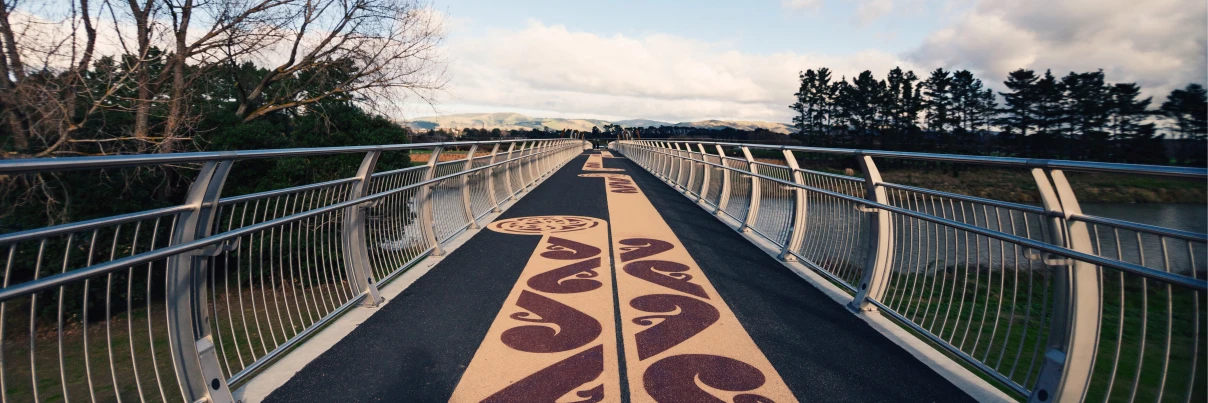
He Ara Kotahi Bridge spans the Manawatu River, connecting Palmerston North's growing network of shared walking and cycling paths.
Manawatu may not immediately come to mind as a solar hotspot, but with around 1,750 sunshine hours per year, it has more than enough sun to make solar panels worth considering for homes and businesses across the region.
Palmerston North's relatively flat terrain suits roof-mounted solar installations well, and the region's growing residential development means more and more new builds are being designed with solar in mind from the outset.

While Manawatu gets more cloud than the sunniest parts of New Zealand, solar panels generate power from daylight, not just direct sun. Year-round generation is very achievable across the region.

Charging your electric vehicle at home using solar power is one of the most cost-effective ways to run an EV in New Zealand. If you have both, it is worth talking to us about how your plans can work together.
Electric vehicles are increasingly common across Palmerston North and the wider Manawatu region. The city's relatively compact layout and flat topography make it well suited to EV ownership, with shorter daily commutes that sit comfortably within the range of most modern electric vehicles.
The region's charging infrastructure has grown steadily, and Meridian’s Zero charge points are available in and around Palmerston North for when you need a top-up away from home. For those venturing further afield, the national network of fast chargers means road trips north to Taupo or south through the Kapiti Coast are very workable with a bit of planning.
For EV owners stuck in stop-start traffic, the efficiency advantages are real. Unlike petrol or diesel vehicles, EVs use very little energy when idling or moving slowly. The regenerative braking on routes through hilly terrain around the Tararua foothills also helps recover energy that would otherwise be lost.
If you are thinking about making the switch to electric, or have recently picked one up, our EV plan is worth a look. Home charging on an off-peak electricity plan can work out to around $2.70 per 100 kilometres, based on EECA's off-peak rate of 15 cents per kWh, compared to $20 or more per 100 kilometres for a typical petrol vehicle at current New Zealand fuel prices.
Learn more about our EV plan or Find Meridian charge points near you
Terms, conditions and eligibility criteria apply

An EV can be a great choice in Palmerston North
Manawatu is one of New Zealand's most productive agricultural regions. Whether you run a dairy operation, a sheep and beef farm, or a mixed enterprise, energy is a significant input cost and we want to help you manage it well.
We have a dedicated rural team who understand the specific demands of farming energy, from irrigation pumps and shed equipment to milking plants and cold storage. Our agribusiness plans are designed to suit the seasonal and operational patterns of farming.
Palmerston North is one of the fastest growing cities in New Zealand, with significant residential development underway in areas like Aokautere. If you are building a new home or working on a development, here is how the power connection process works.
Talk to your building company and electrician early. They will coordinate with Powerco, Manawatu's lines company, to get the right consents in place and plan the network connection for your property.
Get in touch with us. As a Meridian customer, we can help ensure your meter is set up correctly, your connection date is accurate, and your plan is ready to go when you move in.
Powerco and a licensed contractor will complete the physical installation, including any cabling, meter installation, and connection to the network.
If you are experiencing a power outage in Palmerston North or the wider Manawatu region, your first step is to check with Powerco, the local lines company. They will have up-to-date information on planned maintenance or any known faults in your area.
If there is no known fault and your neighbours have power but you do not, give us a call. It may be that a qualified electrician needs to check your mains setup.
From small businesses in the city centre to larger operations out in the district, Meridian powers a wide range of businesses across Manawatu. We have tailored plans and a dedicated team to support you.
Thinking about EV charging for your team, fleet or customers? We can manage the whole process, from site assessment through to installation and ongoing support.
Adding solar to your business can reduce your power costs, lower your emissions footprint and provide resilience during outages. Talk to us about what's possible for your site.
Learn more about how we power important initiatives in Manawatu.
Meridian's Power Up Community Fund supports local projects in communities near our generation assets. Because Te Apiti sits in the heart of Manawatu, communities in and around Ashhurst, Woodville, and the wider Tararua District are eligible to apply.

Got questions? Our team is here to help. Let’s talk about a quote or a power plan that’s tailored just for you.