In 2014, Canadian astronaut Chris Hadfield endeared himself to the good folks of Aotearoa – and Marlborough in particular – by labelling New Zealand’s wine-producing mecca as the most beautiful place on Earth when viewed from space.
A former commander of the International Space Station who spent 165 days orbiting the planet and chronicling his experience on social media, Hadfield’s opinion – which went global thanks to an interview with Britain’s BBC – was well qualified.
“Blenheim, New Zealand, in the lovely centre of wine country,” Hadfield captioned an image that captured the Wairau Valley in all its glory.
If any photo captured the landscape’s transformation from dusty, arid sheep farming country to luscious, green sauvignon blanc central, Hadfield’s snap was it. However, the image was merely a snapshot in time – and one shot with a very long lens.
A more complete understanding of the area’s natural state can be found by taking a short trip back down the valley to the start of the Waihopai Valley Road, where a remarkable wetland restoration project is now into its fourth decade.
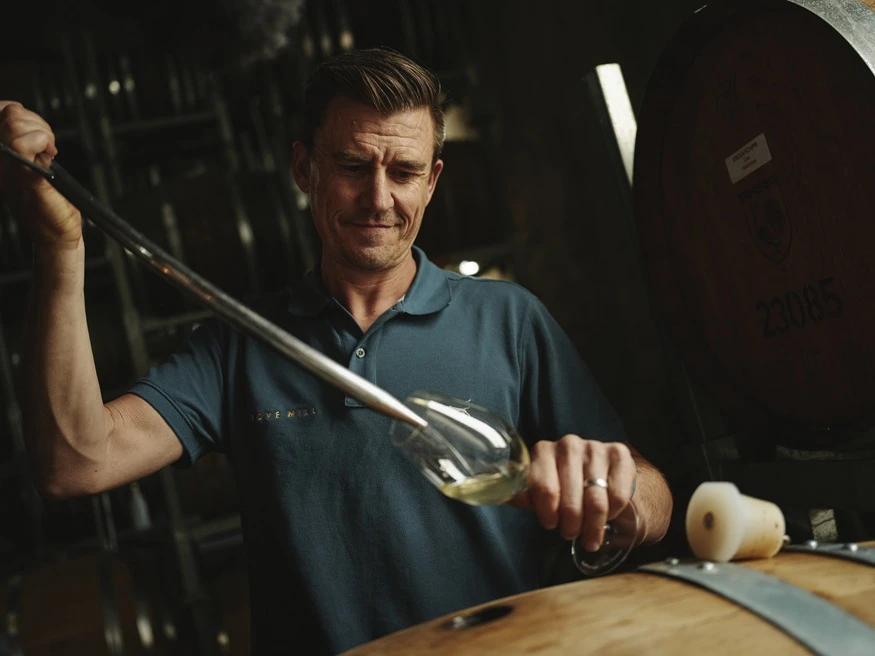
“In Blenheim – Waiharakeke – this is part of the story of Marlborough,” says Foley Wines’ chief winemaker Stu Marfell, gesturing to the thriving flaxes and mature tī kōuka (cabbage trees) that ring a crystal-clear, spring-fed pond located behind Grove Mill winery’s bottling plant.
“A lot of the Wairau Plains would have been wetlands, little swampy and flaxy areas,” says Stu.
“It has all been drained and modified so much that if it’s not now vineyards, it’s just brown. So to re-establish this wetland is quite amazing.”
Founded by a group of progressive business people in 1988, Grove Mill began life in what was originally the Dodson’s ice cream factory adjacent to Lansdowne Park.
By 1992 grape production had already outgrown the winery’s 150 tonne capacity. The company’s board, led by local accountant and prominent rugby administrator Mark Peters, began looking for a new site to underpin planned expansion, settling on a parcel of land at the start of the Waihopai Valley that came with a unique feature.
“We decided to preserve the wetland and try to enhance it as best we could,” recalls Mark.
“We were a little bit ahead of our time. We felt that if we’re going to build a big new winery, raise a lot of shareholder funds, spend a lot of money and list the company publicly then we wanted it to have a good story around it. And we felt sustainability and the environment was important. The rest is history.”
In 1994 Prime Minister Jim Bolger performed the formalities as Grove Mill opened its flagship 1000-tonne winery complete with tasting room and cellar.
By then, the wetland restoration project had already imprinted itself on the company’s DNA.
The endangered Southern Bell Frog had been discovered in the wetland just as the winery was brainstorming a new label to complement Grove Mill.
“We had a really progressive wine maker called David Pearce who was an early enthusiast about sustainability” says Mark. “And we had a marketing guy called Russell Hooper who was very instrumental. We came up with Sanctuary, made the frog a feature of the Sanctuary label and donated money for every case sold to a restoration fund.”
The company was innovative on the energy front, too, developing a system that recycled the heat generated from refrigerating its white wine tanks for warmth to aid the fermentation process in its red wine cellar.
By 2006 Grove Mill had officially become New Zealand’s first certified carbon net zero winemaker.
That commitment to sustainability remains to this day.
In 2025, Grove Mill made another giant leap on the sustainability front, partnering with Meridian Energy to significantly upgrade solar energy generation on the site.
In a classic win-win, Grove Mill’s parent company Foley Wines partnered with Meridian on an arrangement that saw Meridian cover the costs of the installation of the solar system while, in return, Foley Wines committed to purchasing Grove Mill’s power from Meridian for the term of the agreement.
“The cool thing about lots of the sustainable products we sell to our customers is that they make financial sense as well as environmental sense,” says Meridian Energy’s Strategic Energy Partner Emily Sopers.
“Effectively the customer pays for the cost of the panels and install through the purchase of electricity generated over the term of the Agreement. It’s so cool for them.”
Powered by 320 solar panels, Grove Mill’s new 140.8 kWp solar system generates around 160,000 kWh a year, offsetting approximately 20 per cent of the site’s total consumption.
“It’s made a massive difference,” says Stu. “We looked at the average household usage and it was just under the equivalent of 23 houses that we put in. That’s pretty cool.
“It has been great to be able to work with Meridian because it is a big investment. Having someone you can partner with to do it has made it a lot more achievable. They have got the knowledge and the skills and a really great team that were super-organised and professional, just great to work with.”
With Blenheim topping the chart for most annual sunshine hours in New Zealand (beating out Lake Tekapo and Nelson), solar is an obvious choice for renewable energy generation.
“In Marlborough the winters here are so nice,” says Stu. “It might be a bit crisp in the morning, but you get the blue sky and plenty of sunlight. And with solar there are no moving parts or maintenance. Once it is on the roof – apart from an annual wash of the panels – it just does its thing.”
Majority-owned by American businessman Bill Foley – whose other interests include Auckland FC, Premier League football club AFC Bournemouth and NHL ice hockey team Vegas Golden Knights – Foley Wines’ stable includes the Vavasour winery in the nearby Awatere Valley, Mt Difficulty in Central Otago and Te Kairanga and Martinborough Vineyard in Martinborough.
“We’ve got wineries dotted around a fair bit of New Zealand that are all running a very similar sustainability focus,” says Stu.
“It is probably quite a unique setup in the industry in New Zealand because, while all of those wineries come under one ownership, they are all individual wineries with their own winemaking and viticultural teams. It is not all just pulled into one monster factory, it is about keeping it small scale.”
The plan is to make all of Foley’s wineries more sustainable – with Mt Difficulty next in line for a solar upgrade.
“We want to make great wine that people like to drink all around the world,” says Stu.
“That is our founding goal. To make great wine you have to have great vineyards. And to have great vineyards you have to look after the land, and that is what we do and have done for a long time.”
Achieving energy sustainability requires a substantial investment of time and money – a path the company is fully committed to.
“We are not in it for a quick buck,” says Stu. “It is something that has been built over time. Sustainability is woven into everything we do.”
That ‘everything’ includes increasing biodiversity through native planting to help regenerate the adjacent wetland, using sheep instead of tractors to keep grass down in the vineyards and recycling wastewater for irrigation.
“Packaging is another massive area – it is probably one of our biggest when we look at our carbon emissions,” says Stu. “Producing glass requires a lot of energy. We made the decision to use New Zealand-made glass, which has a higher content of recycled glass. It’s not necessarily the cheapest glass but it is the right thing to do.”
Even the labels for Grove Mill’s roughly 120,000 cases of wine have a sustainable element as they are made utilising the fibrous portion left over once the sugar has been extracted from sugar cane – something previously burned as unwanted waste.
These days Grove Mill’s sustainability message travels far and wide, with the globally recognisable brand sold in Australia, the United Kingdom, the United States, South Korea, China and the Pacific Islands.
Stu’s connection to Marlborough’s land and the wine it produces runs deep. He grew up on a sheep farm in the Awatere Valley on a property that neighboured what would become the pioneering Vavasour winery. Helping to hand pick Vavasour’s first vintage as a nine-year-old was his first job in an industry he’s never left, formalising his knowledge with a degree in viticulture at Lincoln University before graduating to become the winery’s head winemaker.
Now the chief winemaker across all of Foley Wines’ brands, Stu describes each year’s vintage as a time capsule that reflects the environmental conditions of the previous 12 months.
Much the same can be said of Grove Mill’s Waihopai Valley winery.
Repairs and upgrades to plant and buildings damaged in the 2016 Kaikōura earthquakes have been engineered to better withstand future shocks, while the bottling plant’s warehouse roof now hosts solar panels that harness energy for daily operations.
“There is more roof space there so over time we are keen to work with Meridian to keep growing it,” says Stu.
The revitalised wetland continues to prosper, providing a home for the native flora and fauna such as the Southern Bell Frog, raupō, Copper Butterfly, Southern Ladybird, Pacific Black Duck (pārera), bees and insects, and New Zealand Falcon (kārearea) that adorn Grove Mill’s labels.
“Every year we’re planting more plants (roughly 1,000 a year), controlling weeds and trapping predators in the wetland,” says Stu.
“It’s pretty cool. Now it has grown up so much it is hard to see into it, so the plan is to build some board walks so people can actually get in there and enjoy it.