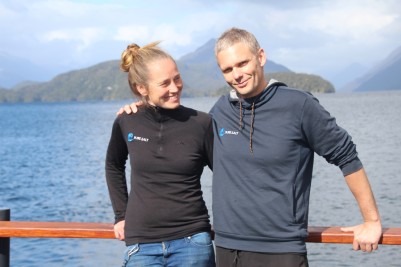
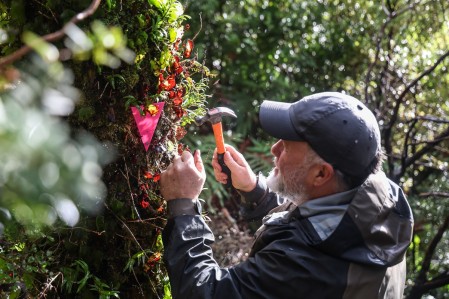
Now, under Pure Salt’s care, kiwi numbers have surged. “We’re getting kiwi in front of 11 out of 12 cameras. And we recorded about 240 kiwi calls across four recorders in only six weeks, including duets.”
It doesn’t stop there. Oystercatchers are massing again. Penguins are doing really well. Robins are holding on. Kākāriki are nesting more. Even seabird colonies are returning.
“It’s a privilege to even think that we get to see any change within a lifetime,” says Maria.
Volunteers are the backbone of much of this work, including from Meridian, which operates the nearby Manapōuri Power Station. The company has long emphasised its responsibility to protect the environment it relies on, and supporting Pure Salt is one way to turn that belief into action.
Meridian’s Head of Sustainability, Tina Frew is one of several Meridian volunteers who’ve joined Pure Salt in the field. She first went south because she loved the outdoors but left with a deeper connection to the work and having had her understanding of ground-level conservation reshaped.
“I went there for adventuring, and I met this crew, got into pest control, and learned how strategic it is,” says Tina. “It’s good for someone in my role to get hands‑on again. Seeing the community good - that’s what sticks.”
The alignment with Meridian’s values is obvious, and supporting Pure Salt allows Meridian staff to contribute directly to the wellbeing of the same region where the company produces so much power.
“We’re a renewable energy company operating in some of the most sensitive natural environments in the country. We have a responsibility to be part of the solution - not just because it’s the right thing to do, but because our communities expect it of us,” says Tina.
Many Pure Salt volunteers return from having formed a stronger sense of purpose, and several have gone on to participate in other conservation projects. Some bring their teams back on board for leadership development, combining environmental work with shared experience. Maria describes it as a ripple effect, with similar partnerships taking off elsewhere.
“I’m very hopeful. Other operators have started linking up with trusts. Some local businesses have approached us and asked, ‘how does this thing work?’ The truth is it takes guts and it takes commitment in the long term. It’s real money off your bottom line. It’s not something nice to do on the side as a one‑off campaign.”
Despite all the progress, Maria emphasises that the job is far from done. She points to the three pillars of conservation tools - detection, attraction, and dispatch - and notes that the first two are still underdeveloped. Tracking tunnels and cameras provide signals, not certainty. Attraction tools rely mostly on food lures rather than behavioural science. “Would you start anything in business without knowing whether your tools work?”
That’s why Pure Salt is looking for thinkers as well as walkers: engineers, coders, designers - anyone with a fresh approach. A new charity is underway, and a second vessel is being built to expand the work both in Fiordland and across the Pacific. The aim is more adventures, more coverage, more capability. “We need to get going,” says Maria.
She says that what makes the work so special is how human it feels. The boat is full of lists and data sheets, but also shared meals, wet socks, and long conversations. People arrive as visitors and leave as guardians.
“Imagine every single business in New Zealand giving something back—that’s where I’d love us to end up.”
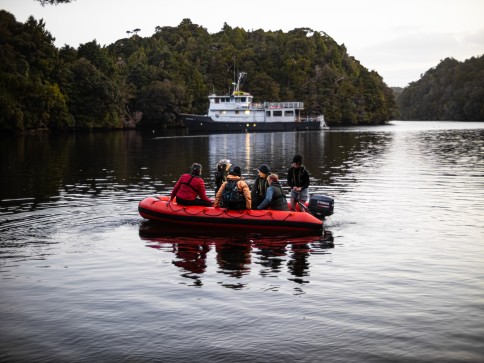
Pure Salt tour group